


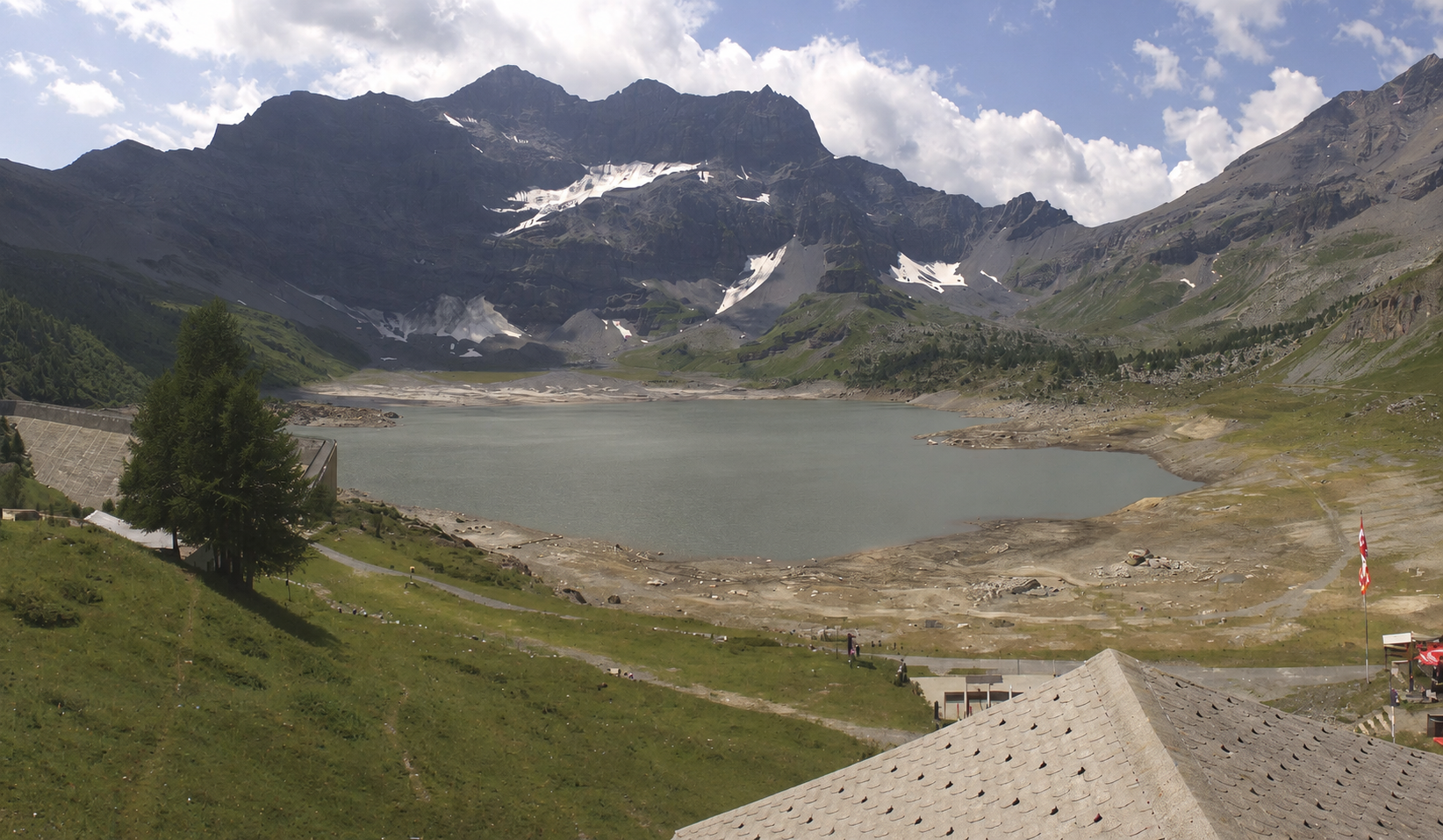
- Le niveau d'eau du barrage de Salanfe est bas au point de pouvoir observer des berges habituellement immergées. © Salanfe.ch/webcam
Le niveau du lac de retenue du barrage de Salanfe est bas cet été. Une situation qui s’explique par un hiver peu enneigé et une pluviométrie limitée, mais qui ne présente pas de danger ni d’inquiétude pour la production électrique.
À Salanfe, les berges habituellement immergées sont visibles depuis plusieurs semaines. Pourtant, malgré un niveau de retenue inhabituellement bas, la situation reste dans les normes pour cette période de l’année. Selon Michael Plachy, responsable de la production hydraulique chez Alpiq, plusieurs facteurs expliquent cette baisse.
« Il y a eu une pluviométrie cette année assez faible de manière globale, et surtout des volumes de neige qui ont été plus bas », explique-t-il. La fonte du manteau neigeux, qui alimente progressivement les barrages entre mai et juillet, a donc apporté moins d’eau que lors d’une année classique.
Le cas de Salanfe est toutefois particulier : contrairement à de nombreux grands ouvrages valaisans, le barrage n’est pas alimenté par des glaciers. « Normalement, l’effet est compensé par la fonte des glaciers. À Salanfe, on n’a pas cet apport supplémentaire », précise Michael Plachy.
Michael Plaschy, Responsable de la production hydraulique chez Alpiq
Une réserve plus basse, mais une gestion adaptée
Le niveau actuel du lac reste néanmoins loin d’une situation critique. Salanfe n’est pas considéré comme un ouvrage stratégique pour l’approvisionnement électrique suisse. « Ce n’est pas lui qui va impacter la sécurité d’approvisionnement en Suisse », rappelle le responsable d’Alpiq.
Le barrage affiche actuellement environ 3 millions de mètres cubes d’eau, contre une moyenne proche de 9 millions sur les dix dernières années. Une baisse importante, mais qui intervient après une année 2025 déjà très basse. « L’année dernière, on était à 2 millions de mètres cubes, donc on était encore plus bas », souligne Michael Plaschy.
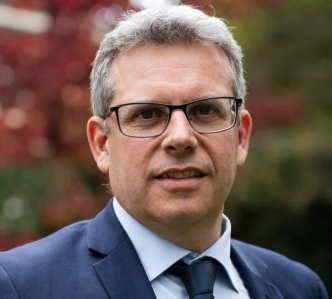
"Ce n’est pas le barrage de Salanfe qui va impacter la sécurité d’approvisionnement en Suisse ."
Adaptation vis-à-vis du marché
La production est également adaptée à la disponibilité de la ressource. Lorsque le lac est moins rempli, les exploitants arbitrent les moments où l’eau est utilisée afin de maximiser sa valeur. « Quand le lac est un peu vide, ça veut aussi dire qu’on a pu bien optimiser cette eau », explique-t-il.
À plus long terme, les exploitants observent attentivement l’évolution du climat. Pour anticiper les changements liés notamment à la fonte des glaciers, Alpiq collabore avec des institutions scientifiques comme l’École Polytechnique Fédérale de Lausanne afin d’établir différents scénarios d’évolution des apports en eau. L’objectif : garantir la capacité de stockage et de production hydraulique pour les prochaines décennies.
Michael Plaschy, Responsable de la production hydraulique chez Alpiq
/LT